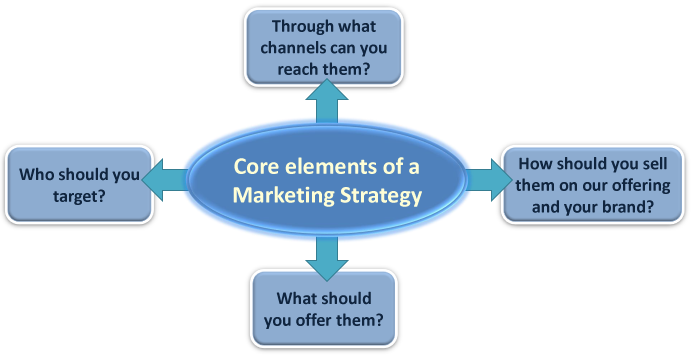
Strategic Marketing Framework to print out & hang on your wall at work

I've found this framework to be immensely helpful to me throughout my career.  Particularly during those fire-fighting, short-term focused periods of work that we all experience from time to time, this framework has always helped me to reorient myself & recalibrate.     


There's a lot more to come with the framework - I'll be drilling down into the different dimensions in more detail so you can have a richer understanding for how to use it to develop robust new marketing strategies and to improve existing ones.

Please feel free to email me if you have any questions about how to put the framework to use within your business.


Using segmentation to develop your marketing strategy

While there are many ways to harness the power of segmentation, one of the broadest and most valuable applications is for designing your marketing strategy – a strategy that clearly defines who you’re targeting, what you’re going to offer them, where you’re going to reach them, and how you’re going to sell them on your product & brand.

The key “superpower” of segmentation is that it enables you to take a population of consumers and group them based upon similarities they share with respect to the very attributes that you use to define your marketing strategy (i.e., who to target, what to offer them, etc.). What this means is that the segments you derive from the segmentation process will have their preferred marketing mixes already “baked into them”. Powerful stuff.


Segmentation for designing marketing strategies is a 2-step jig


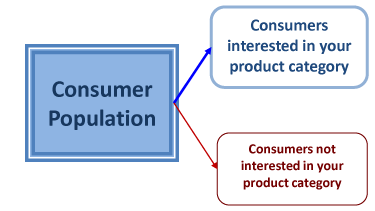
Step 1: Identify “the who”

In the first step you identify “the who”. Who are those consumers in the population who have expressed interest in your product category or who have needs addressed by your product category? In this step you’re simply separating out those interested consumers from the rest of the general population.


Step 2: Identify your target segments
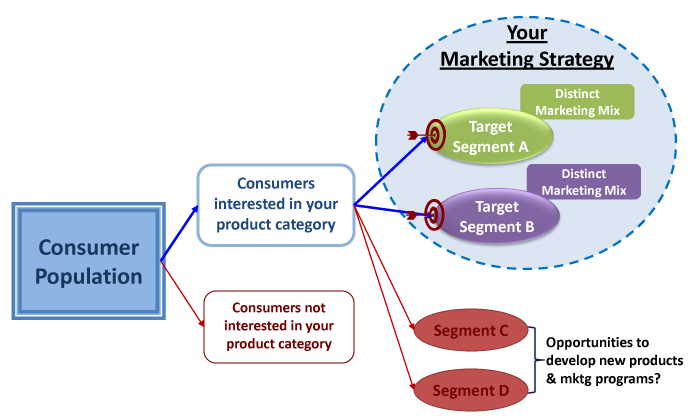
The second step is where things really get cooking. In step 2 you take the population of interested consumers and group them based upon their similarities with respect to “the what, why, where & how” of your product category.

In this step your goal is to identify the most attractive segments for your business to target – segments for which the following are true:
  • One or more of your products meet the segment’s functional & emotional needs
  • Your existing channels for selling, servicing & awareness-building align with the segment’s channel preferences and media-consumption habits
  • Your product & brand positioning align with the segment’s “reasons for buying” from both a functional and emotional perspective
  • You can identify the segment in a cost-effective manner
  • The segment is large enough in size and profit-potential to merit investment in a distinct marketing mix
By the end of step 2, you will have identified one or more segments that:
  • Are interested in one of more of your products
  • Are most effectively targeted using a distinct marketing mix
  • AND, are large enough to merit your investment in this distinct marketing mix

These segments will become your target segments and along with their distinct marketing mixes represent your marketing strategy. To reiterate from the intro, the beauty of this approach is that by basing part of your segmentation on similarities shared by consumers across key components of your marketing mix, the segments you derive come with their “marketing instructions” already included.


What about segments you choose not to target?
So what about segments that don’t meet enough of your targeting criteria? What should you do about them? The answer is that it depends.

For those segments large enough in size & profit potential you may consider developing new products, building out new channels, or creating communication strategies that better meet their needs and more effectively “speak to them”.

On the other hand, for those segments that are very small or that would require major retooling of your operations, extensive employee training, or significant stretching of your brand, you would likely leave to other companies to pursue.


More posts on segmentation & marketing strategy:


Great books & articles on segmentation:

Snapshot of some of my favorite business books

So I was in my office today and my Droid was nudging me to take a quick snapshot of a stunning view of some of my favorite business books... it's so hard to say no to a Droid...


----------

Search Engine Optimization for Dummies and Dummy-Impersonators

This post is for those of you who see the acronym SEO and feel your throat tighten, your palms begin to sweat, and think to yourself, "ughhh, I know we need this SEO stuff for or to our website, I only wish I knew what SEO stood for!.." (And no, you're far from a dummy if you find SEO confusing - I used this title purely to help my Google page rank for this post ;) 

No matter how confused you ever become about Search Engine Optimization, if you remember the following you will always be able to reorient yourself and make a quick "recovery":


Google is just a librarian and SEO is simply good book labeling.
[say what?]


Google is just a librarian...
Think of Google as the head librarian of our 21st century digital library - a library filled with all the world's websites, including yours.

Google's job is simply to provide its patrons (i.e., users of its search engine) with the best information on the topics they are searching for, usually provided in the form of website links, images or videos.

For example, let's say a nice, eligible bachelor named Larry wants to find out what he can do to "tame" his fiery dragon breath and make it past date #1. Larry comes up to the library counter (i.e., www.google.com) and asks Google for information about Halitosis. Google, at lightning speed, runs to the Halitosis section of the "library", and grabs ALL of the websites on Halitosis. When Google returns to the counter, she places all of the Halitosis sites in front of Larry, sorting them from most relevant & most popular to least relevant & least popular.

That is Google's search engine in a nutshell.  (And yes, it was recently revealed by the company that Google's search engine is in fact female)


...SEO is simply good book labeling
So how does SEO come into play within this "digital library" of all the world's websites?  

Think of SEO as the process of effectively labeling & categorizing your website so that Google understands what your site is about and therefore knows when to include it as part of a person's search results.  

Going back to our Halitosis example, imagine there are 2 websites on the topic of bad breath.  Site A's name is, "How to Eliminate Bad Breath", and site B's is, "Fighting the Enemy One Brush at a Time". 

The main sections of site A (think titles of book chapters) include definitively breath-related headings like "Where bad breath comes from", "Top tips for beating Halitosis" and "Why brushing alone won't prevent bad breath".  In contrast, the main sections of site B include somewhat vague, albeit more humorous headings such as, "Readying for battle", "Exorcising your tongue", and "The war within". 

Which of these 2 websites do you think Google would rank higher on the list of Halitosis sites it returns to our eligible, yet breath-challenged bachelor?  Unfortunately it's not the site with the more creative copywriter.  Sorry. 

Google's no poet, so easy on the metaphors
While Google is one heck of a librarian, she's not a mind reader - at least not yet.  In other words, you need to be extremely clear and literal with your website content, especially when it comes to major headings & titles.  

Think of it this way - if you're thumbing through a book trying to figure out what it's about, you're most likely going to look at the book's cover, leaflets, chapter names, and index.  Google ""thumbs through" your website in much the same way.  So cute and overly metaphoric titles like "Making it to date #2"  will only help drag your site's Google ranking down... and with it, your website traffic.

Now that you hopefully have a better 50,000-foot view of SEO, below are a few resources that I've found to be particularly insightful for SEO newbies. 


GODZILLA ILLUSTRATION: TANYA DASHEVSKY
   

Additional SEO sources for beginners looking to get a little dirt on their hands

      "Would you like a coke with your product-sandwich?"

      How many times have you been asked the above question at your local wine store?

      "Huh?" you say.... okay, so maybe you weren't asked the question explicitly... instead it was embedded in the array of differently priced wines displayed throughout the shop.

      For those of you who, like me, know little about wine, when was the last time you went into a wine store and bought the cheapest wine on the shelf? When was the last time you bought the most expensive wine on the shelf? My guess is that most of you can't recall the last time you did either because when you go to the wine store you "play it safe" and usually buy a wine priced "somewhere in the middle". I know I do.

      Little did you realize that your local wine store was employing a product-sandwich strategy, drawing you helplessly towards that mid-priced bottle of wine! And you thought you were in control! :)


      What is a Product-Sandwich Strategy?
      In a nutshell, the strategy involves creating/selling a (very) high-priced version of your product so that the next price down appears more moderate in comparison. Often times this "next price down" would be considered expensive by the customer in absolute terms, but in relative terms (i.e., next to your "Rolls Royce" model) it appears reasonably priced. If implemented successfully, the net impact on your business is a boon in sales of the mid-priced version.


      Why does the Product-Sandwich Strategy work?
      The Product-Sandwich strategy is based on the principle that when buying an unfamiliar product or service people tend to purchase a mid-priced version of it. Why? It all comes down to risk aversion - fear of making a bad purchase and flushing money down the toilet bowl. This toilet-bowl-infused aversion is the reason we shy away from the pricey models ("How much better could that stereo possibly sound?") and reject the cheap ones ("I bet this stereo would die after a month!").


      Can I use a Product-Sandwich Strategy in my business?
      Businesses that sell hard-to-value goods (e.g., perfume, body lotion, wine, caskets), or whose target customers tend to be product novices are generally best suited for a Product-Sandwich strategy.

      • Think selling perfume to people who don't know the difference between eau de toilette and the water in their toilets.
      • Or selling car oil to someone who doesn't happen to have a name embroidered on his shirt.

      Make sure customers are made aware of the range of price points
      One critical success factor for any product sandwich strategy is to ensure that your customers are aware of the different price points of your products, most notably your high-priced version. It is this awareness that leads your customers to view the mid-priced products as the mid-priced products, and hence the "safe, yet reasonable choice".


      What do you think?

      Have you ever employed a product-sandwich or similar such strategy? If so, how successful was it? What did you learn? What worked? What didn't work?

      What ethical issues, if any, does this bring up for you? Do you view this as psychological manipulation or just good, plain marketing strategy?

      Please share your experiences, comments, thoughts or questions.


      Additional info sources on Product-Sandwich strategy & the psychology behind it

      ...and for those who really hate wine stores & happen to have iPhones

      Using the 5Ws to reduce customer churn

      My love for the 5Ws was professed (or at least implied) in a prior post, proving that I am not afraid to express my deep affection for abstract concepts - luckily I have a very understanding wife. So here we go again, another ode to the 5Ws, one of the simplest yet most powerful ways to generate ideas to improve your business.

      Let's kick things off with a marketing poem that's all about reducing customer churn... or as I like to put it, fixing those darn leaks in your bucket 'o customers:

      There's a hole in the bucket, dear Liza, dear Liza...
      Then fix it dear Henry, dear Henry, dear Henry...
      With what should I fix it, dear Liza, dear Liza?...
      With the 5Ws dear Henry, dear Henry, dear Henry
      With the 5Ws dear Henry, dear Henry, with the 5Ws...

      How to use the 5Ws to reduce customer churn
      1. Use the 5Ws churn matrix to generate ideas. Use the 5Ws Customer Churn Matrix (see it below) to generate as many ideas as possible for why customers might cancel or reduce the use of your product or service. You will be amazed at how rich & vivid your perspective on your customers will become (no, I didn't borrow this line from an infomercial).
      2. Validate your ideas. Which of your ideas actually result in customer churn? There are a number of ways to validate your ideas, from surveying canceled customers to bouncing them off customer service reps.*
      3. Find the biggest leaks. Of the cancellation reasons you have validated, which ones account for the largest % of customer attrition? You want to make sure you focus your attention on the biggest chunks to maximize the business impact of your efforts.
      4. Design ways to plug the holes. How can you reduce or eliminate the biggest drivers of customer churn? Common strategies include making enhancements to your product or service, creating promotional or loyalty programs, retraining your sales & service reps, altering your approach to distribution, and developing new partnerships.
      5. Plug away! Unfortunately it's not enough to simply think up cool & innovative ways to reduce customer attrition... you have to execute, execute, execute...
      6. Measure & adjust. What's working? What's not working? What could work if you made a few minor tweaks? At this point you're looking to optimize your strategies through ongoing measurement & adjustments.
      5Ws Customer Churn Matrix

      Please share your experiences!

      Enough about the 5Ws and my curious fascination with matrices! How do you go about identifying why your customers cancel your service? What have you found to be most effective? Please share your experiences - good, bad or ugly.


      Additional posts on using the 5Ws to improve your business

      *While you should
      always be surveying canceled customers and speaking with service reps, arming yourself with the ideas generated from the matrix will significantly enhance the value you derive from these activities.

      Marcom case study: the “Hyatt Shuttle” of New York’s Grand Central Station

      Hyatt Shuttle Marketing CaseIt’s not often these days I’m stopped in my tracks (no pun intended) by an ad or related form of marketing communication. Most of them seem to fuse with the background becoming invisible in mere seconds. This week was an exception, however, and it underscores one of the core principles any marketer should keep in mind when crafting effective marketing communications…


      My encounter with "The Shuttle"
      As I boarded the Shuttle train this morning, half-awake from my morning coffee, I was brought to full attention by a completely transformed subway interior (for those unfamiliar, the shuttle is a train that runs between Time Square & Grand Central Station in NYC). Beyond the expected surprise I felt from entering a subway car that had been bathed in the accoutrement of a solitary theme, there were a few reasons in particular that made the experience so memorable. And, it serves as a great example of how marketers can cut through the clutter – objective number one for any marketing communication. This feat was all the more impressive give
      n that it was competing head-to-head with the madness that is midtown Manhattan during morning rush hour.


      Why the Hyatt Shuttle = effective marketing communication

      So what made the experience so compelling?

      For starters, the train’s interior broke any existing schema (or expectation) I had for “what the
      unexpected marketinginside of a NYC subway looks like”. Instead of steely, cool panels, the train was affixed with faux wood “wall paper” reminiscent of some bachelor’s finished basement from the late 70s, pool table & wet bar not included.

      In place of slick, high-design ads pressed into the metal picture frames that dot the subway’s interior were color graphs printed on basic white printer paper; graphs that reminded me of the simple bar charts Microsoft Excel spit out circa 1989 . The charts, whose effectiveness was heightened by their simplicity, depicted how much more successful
      effective marcomface-to-face meetings are in comparison with video conferencing, email, or phone calls.

      At its essence, Hyatt transformed a cold, unfriendly space (the inside of a NYC subway) into a warm, inviting place - the inference being that Hyatt Conference Centers create the type of warm, inviting atmospheres conducive to effective business schmoozing & networking.

      Now I’m neither an event planner nor coordinator of large-scale meetings, so I cannot speak to the level of influence "The Hyatt Shuttle” might have on my decision-making for those upcoming conferences.

      However, to some degree that’s irrelevant. “The Hyatt Shuttle” compelled me to whip out my blackberry on a crowded train and snap away - much to the annoyance of my fellow commuters. It got me to write this post with blurry crackberry photos attached for the entire world to see (or 0.00022% of the Internet world per my latest Alexa rankings). And perhaps most compelling - Hyatt was able to convert me into an online PR guy who’s apparently willing to work for free. All Hyatt had to do was serve up a unique experience that added a little bit of zest to my otherwise predictable day. Clever, high-ROI strategy… and heck of a marketing communications case study for marketers to sink their teeth into & leverage for their own business.


      The Law of the Unexpected
      Let’s bubble-up this mini case study and see what useful principles we can derive for you to use in your business… at its core, what made The Hyatt Shuttle so compelling is that it successfully employed the law of the unexpected, which simply states that throw something out there that I don’t expect and you’ll capture my attention... think giraffe in a field of cows, an orange in a bowl of apples, or your waiter at The Four Seasons dressed in a white t-shirt & cut-off jean shorts.


      How to apply the law of the unexpected to your marketing communication
      Let's get right to what you're no doubt wondering - how to apply the law to your own marcom efforts... (to be continued... coming soon...)


      If you’d like to read more about the law of the unexpected and other means for cutting through the clutter, I highly recommend:

      Engaging Influentials: Twitter and Beyond

      By David Capece, Managing Partner at Sparxoo

      With the rapid adoption of social media, we have accelerated into a network economy. In a network economy, connectivity enables value to be created and shared by network members. The larger the network, the greater the potential benefits. In the digital world, network activities take place on an open platform that enables participation and cloud computing (think Wikipedia and widgets).
      laws of influence
      In networks, some members are more connected and active, and therefore have more influence. These influentials are important members because they add significantly more value to the network. In the digital world, they blog, twitter, upload videos, experiment with new gadgets, and create widgets. As early adopters, they tend to be trendsetters that are followed by their friends and sometimes the masses. The book, the Whuffie Factor, talks about Social Capital, and how our society is increasingly motivated to become more useful and creative. Today, more people want to be influencers, and they want to be enabled.

      In 2009, Twitter has emerged as one of the most talked about platforms in the network economy. Indeed, there is a simple network exchange on Twitter: influencer creates bite-size content, and follower discovers new information. Here are a few examples of the exchange:

      • Gavin Newsom, mayor of San Francisco and California Governor Candidate, has over 500,000 followers. He keeps his followers informed about upcoming events and fundraising, and enables them to interact with him directly.
      • Mike Massimino, a NASA astronaut, has over 400,000 followers. He combines his human life story with a behind the scenes look at being an astronaut.
      • And of course there is Oprah, approaching 1.4 million followers.
      Twitter makes it easy to share your voice and build your presence in the community. RegularGeek’s comment sums up the value: “Even someone like myself, and I do not have a huge social media presence, can talk to and possibly influence about five thousand people. If I have two thousand subscribers on the blog, Twitter, FriendFeed and Facebook, the number of unique people could be around 5,000. That is direct contact, and the network effects could create an audience much larger.”

      While we are all familiar with Twitter, there are many more communities that engage and enable an influential audience with network principles. One of the key elements of a network is the idea of reciprocity. The idea of “I win, you lose” doesn’t work in a network, or it will fall apart. Instead, there must be mutual win-win exchanges. One such example is at Triggerstreet, was founded in 2002 by Academy Award Winner Kevin Spacey, which is a community for emerging artists. The promise of the network is to democratize exposure and offer a career boost through a network of peers who review your work, rate it, and provide feedback. Further, the network has engaged influentials in the form of participating judges, including Michael Myers, Sean Penn, Snoop Dog, Sheryl Crow, and Liv Tyler.

      It is this very concept of participation by influentials that is becoming increasingly important with each passing day. In our world of choice and overcapacity, influentials are an important element of the decision making process. As we de-emphasize paid media such as television commercials and print ads, the power of earned media and word of mouth is amplified. As you consider new ways to share your story and build your reputation, learn from entrepreneurial initiatives that listen to and engage the influentials.

      Our first example is Jodangle which helps you listen to and monitor the online chatter by influentials. In an environment where influential content originates from an exploding number of information sources, Jodange provides intelligence on who and what is influencing customers, competitors, and the overall marketplace. In April 2009, Jodangle received $1.2 million of investments.

      Our second and third examples are currently in development at DreamIt Ventures, which helps entrepreneurs launch their ventures and build great companies. Trendsta is a new way for trendsetting teens to test and review the latest hot products. Like BuzzAgent, the principal is that word-of-mouth marketing is powerful. Trendsta has even more of a laser focus on the influentials by engaging trendy teens in the digital world. Our final example is Scribnia, which is a rating and discovery engine for bloggers and columnists. Much like Triggerstreet, the promise is to build an influential community that is engaged in sharing creative work and providing feedback.

      Consider your role in the network economy. How you are going to add value to and expand your network? As you build your presence and your reputation, listen to the conversation around you, pursue authentic participation, and engage influentials who can amplify your message.

      Original post: http://sparxoo.com/2009/07/01/engaging-influentials-twitter-and-beyond/

      Grow or die! Product fertilizer to grow your top line

      Apologies on the overly dramatic, “please-read-me!” title. I figured I’d jump into the pool with the rest of the bloggers attempting to get the attention of the 1.6 billion of you bouncing around the virtual world.

      Anyhow, you’re probably familiar with the phrase, “whatever stops growing eventually dies”. And, while I don’t subscribe to this black & white, morbid declaration, we all know that when it comes to your business, growth is essential.

      So in the spirit of doing my little part to help get our economy back on its feet, I’ve decided to write a series of brief articles about different growth drivers (tools, frameworks) you can use to grow your products & your business, and perhaps even add a few inches to your height. So let’s get started…


      Growth driver #1: develop different versions of your product to suit different usage scenarios


      Take mustard. Yes, mustard.

      You’re at a baseball game with some friends. Perhaps you’ve enjoyed a few beers. You head out to one of the fine stadium restrooms to reduce your inner-bladder pressure, and you decide to pick up a hotdog on your way back to your seat. Guldens, right? The perfect neon-yellow goo to spread on your ‘dog. No questions asked. Right place, right time. Guldens all the way.

      Flash forward 2 months. You find yourself at a very formal cocktail party. Pinkies out, fancy degrees flying about, drinks you would otherwise never drink, people doing their best to inject British-inflexions. You make your way over to the hors d'oeuvre table and sample a selection of finely smoked meats. Grey Poupon, anyone? Again, no questions asked. Right place, right time. It’s a Grey Poupon moment.

      (sorry, I just couldn't help but include the most classic Grey Poupon commercial ever produced. enjoy!)


      Let's put aside the mustard and put growth driver #1 to work for you:
      1. Make a list of the different situations in which your product or service is used (or needed).

      2. For each scenario you’ve identified, jot down those characteristics or dimensions that make it different from the other scenarios on your list. Characteristics could include the physical environment, the people you’re with, your main objective at the time you use the product, your main reason for needing the product, the time of year, the activity you’re engaged in at the time you need the product, etc.

      3. For each scenario ask yourself what changes you could make to your service in order to provide greater value to your customers given the unique characteristics of the situation.

      Examples could include adding complementary services, increasing or decreasing the performance level of certain features or dimensions, adding or eliminating certain features, making changes to physical dimensions of the product, etc. Whatever you come up with, it should be dictated by the unique needs of your customer under the given scenario.

      Real-world examples of growth driver #1. Different versions of the product for different usage occasions.

      • Candles: For romantic dinners, for keeping the bugs away when camping, for festive holidays, for scenting the air, for birthdays.
      • Travel insurance: For safaris, for ski trips, for family vacations, for cruises, for long-stay trips, for international trips.
      • Suits: For hot climates, for formal events, for casual events, for outdoor events, for weddings, for funerals.
      What other examples can you think of? Please share them with us in your comments.

      Happy growing!

      -------

      Additional posts that discuss growth strategies
      :

      Great books that discuss scenario-based product innovation:

      Show-Don't-Tell Marketing: enhance your marketing communications by using "picture-words"

      "Show, don't tell!"
      Yes, that annoying piece of feedback you received from your your 6th grade English teacher in creative writing class is as important for marketers to practice as it is for writers of fiction.

      Let’s illustrate the point by looking at the following tag lines:
      • "Use Lowenstein’s fertilizer and ensure the health & vitality of your lawn!"
      • "Use Lowenstein’s fertilizer – it’ll make your lawn so green, so thick, and so soft you’ll ditch your bed and sleep outside on your grass!"
      So how do these two tag lines differ? (Other than the 1 sentence vs. 2 sentence thing)

      Unlike tag line 2, you can’t see tag line 1 in your mind’s eye. T1 uses non-visual, conceptual words like "health" and "vitality". T2 goes the visual route. It paints a picture in your head - you sleeping on a plush bed of the greenest grass.

      Tag line 2 brings the benefits of Lowenstein’s fertilizer to life. Tag line 1 requires that YOU bring it to life, which requires mental energy – a non-starter for today’s consumers.

      An easy tool for improving your sales & marketing copy


      Step 1 - Assess
      Take your sales copy, email campaign, landing page or what have you, and ask:
      • Do the words paint a picture in my mind? How vivid is that picture?
      • Does the picture clearly express the core benefit of my product? (Why paint a beautiful picture that doesn’t help sell your product?)
      Step 2 - Identify
      Identify the conceptual/abstract words in your copy – those words that don't paint clear pictures in your head.

      Step 3 - Improve
      Take the list of conceptual words you identified in Step 2 and do either of the following:
      • Replace these conceptual words with visual counterparts
      • Add visual words to your copy that bring your conceptual words to life. For example, if you're using the word "healthy", you can add visual words like "32-inch waistline", "glowing, beautiful skin", "well-sculpted muscles", etc.
      In closing... whether your 6th grade English teacher had strong coffee breath, a grating voice, or a curious way of holding his chalk, when he shouted those three little words, “Show, Don’t Tell!” he was speaking the Marketing Gospel. Heed his words. Because if the consumer can't see the benefits he'll receive from your product, the consumer won't buy it. Amen.

      How to unleash the power of context and turbo-charge your marketing

      There are few more powerful insights you can generate than learning the main contexts in which demand for your product/product category arises. Having such knowledge will allow you to elevate your marketing and develop deeper, more profitable relationships with your customers.

      ------------

      Step 1: identify the most frequent demand contexts
      The first step in unleashing the power of context is to identify the different contexts in which demand for your product is triggered. Think of yourself as a detective attempting to answer the questions:

      • Under what situations do people become interested in my product?
      • What triggers their interest in my product? (Events, changing circumstances, etc.)

      In sleuthing your way to an answer, you may find that there is a series of events that take place before demand is sparked. You will also likely learn that there are several distinct demand contexts for your product, some of which will occur with far greater frequency than others.

      Your key objective in step 1 is to assemble a list of those demand contexts that account for at least 75%-80% of total demand for your product/product category.


      Step 2: ask the 6 power-questions to elevate your marketing strategy
      For each of the most frequently occurring demand contexts for your product, ask the below six questions:

      1) How can I tweak or reconfigure my product to better meet the consumer need in the given context?

      2) Are there complementary products or services I should consider offering, whether thou
      gh my company or a partner?

      3) How might I adjust my pricing to better reflect the value provided by my product within the given context?

      4) How can I more effectively communicate & position the value provided by my product within the given context? Is there specific imagery, tonality & language I should use in my marketing communication?

      5) Are there any changes I should make from a channel perspective, whether it be my channels for building awareness, for selling, or for servicing customers?

      6) How can I detect when demand has been triggered for this given context? Can I actually identify these people with some degree of certainty? (Dig deep to answer this crucial question. There is almost always a way)
      (Note that some of the questions may not be pertinent for certain product categories and demand contexts)


      Let's make this pop! with a brief real-world example

      Product du jour: Cars


      Step 1: identify the most frequent demand contexts for cars
      -The lease is expiring on the existing car
      -The price of gasoline jumps and the person owns a gas-guzzler**
      -The car is old & worn out (tail pipe tickling the pavement, etc.)
      -The car died & resuscitating it would cost a whole lot of money
      -The person is moving from the City to the ‘Burbs

      Step 2: ask the 6 power-questions for each frequently-occurring demand context for cars
      **Below I've answered the questions for the demand context in which the price of gasoline jumps and the person owns a gas-guzzler

      1) How might we tweak our cars to better meet the needs of the owners of gas-guzzlers?
      We could develop a fuel-efficient car or one that could run on cheaper types of fuel (given the long R&D cycle for new models, auto companies are always best suited to have such a model either always available for sale or one that can easily be ramped up for production)

      2) Are there complementary products or services we should consider offering, whether though our company or a partner?
      We could develop services or partnerships that would cheapen the price of gas - e.g., partner with credit card companies to develop attractive cash-back rewards on gasoline purchases

      3) How might we adjust our pricing to better reflect the value that our cars provide to owners of gas-guzzlers?
      Consumers who are feeling increasing pain at the gas pump are likely willing to pay more for a car that will significantly reduce their “gas pains”... Then again attempting consumer-level pricing can be tricky and a risky move from a brand perspective (not to mention the current distribution structure for cars does not readily lend itself to such a pricing strategy).

      4) How can we more effectively communicate & position the value provided by our cars to owners of gas-guzzlers? Is there specific imagery, tonality & language we should use in our marketing communication?
      We could position our cars as “fuel-smart” alternatives that could save them thousands of dollars, which could be put towards more enjoyable things than gasoline, such as a much-needed vacation in the Caribbean(!)

      5) Are there any considerations we should make from a channel perspective, whether it be our channels for building awareness, selling, or servicing?
      (Response not included to maintain brevity)

      6) How can we detect when this demand trigger has been fired? Can we identify the owners of gas-guzzlers during a spike in gas prices?
      Knowledge of rising gas prices is a layup - CNN & our local gas stations would make any major rise in gas prices abundantly clear. And, there are a number of ways to identify owners of “gas-guzzlers” with fairly good precision, starting with identifying the geographic distribution of SUV sales & SUV dealerships.


      Your assignment
      1) Select one of your products or services – especially one that you believe has the most “improvement potential” & could provide the most upside for your business.

      2) With a pad & pen in hand, walk the product through Step #1. Also, ask colleagues and friends & family to complete Step #1. And, hold a brainstorming session if timing & calendars permit. (I’ve always found the collective IQ of a good group to be far greater than any
      one individual flying solo)

      3) Take each of your top demand contexts and run through Step #2. For this step it is particularly valuable to hold a brainstorming session or two, as the collective brainpower of your colleagues in this step can be the difference between a $1mm idea and a $10mm idea.

      4) Share your experience with us here on the blog, including any interesting things you learned from the process and, of course, any successes you have to-date.


      A note on business strategy & demand context
      In a future post I’ll be writing about the role that the demand contexts of your product should play in (re)designing your business strategy. Depending upon a number of factors including the economics of your business and the positioning of your brand, there are likely certain demand contexts that you would want to focus your efforts upon. More to come on this, so stay tuned...

      And, as always, please feel free to leave a comment, question or shout-out.


      Sources: car demand contexts based upon 2005 study by the American International Automobile Dealers (AIADA).

      Injecting some Maslow into your marketing

      What would you say if I told you that just a few miles off the coast of Australia was a tiny island where a man's success was indicated by the colorfulness of his shirt? Think male peacocks or Seinfeld-as-pirate, whichever is easier to visualize.

      For fear of defaming the semester I studied anthropology in London, I will leave the "anthro-isms" to the anthropologists. That said, we in the US are as knee-deep in symbols as the aboriginal cultures of Papua New Guinea. Of course, most of our symbols have been manufactured by companies competing for our attention & disposable income - and some of them have done remarkable jobs imbuing seemingly ordinary "objects" with profound meaning.


      American Express & Maslow
      Case in point - American Express, a company that successfully turned a tiny piece of plastic, into a symbol that represents the fulfillment of one of Maslow's core human needs: the need to feel significant. Companies, such as Amex, that successfully transform their products & brands into symbols that represent the fulfillment of a Maslow need are often some of the most successful.

      This has no doubt been one of the biggest success factors for American Express since it introduced its charge card fifty years ago. The card quickly became a powerful symbol of one's success (and hence significance); pulling it out from one's wallet generated a profound "buzz", filling one with feelings of pride, accomplishment, and a rush of endorphins. Pretty wild to think that a little piece of plastic (or back then, a piece of paper!) could mimic the feeling one might get from a quadruple espresso or pulling up to one's high school reunion in a shiny red Porsche.


      How to inject Maslow into your marketing

      While your company or product might not have the tailwind of 150 years of brand-building at its back as Amex does, thinking about how to inject aspects of Maslow's hierarchy of needs into your marketing is an absolute must.

      The key to achieving this is to first identify which of Maslow's needs is addressed by your product or service - and yes, it may address more than one. Then, ask yourself the following questions to stimulate your thinking and get the ball rolling:

      1) How can my marketing better communicate how the benefits of my service satisfy this Maslow need?

      • Example: the old “reach out & touch someone”AT&T ads are a perfect illustration of taking the core Maslow need filled by phones - social connectedness - and bringing it to life in compelling, emotive ways.


      • Note: if you don't see the video of the old AT&T ad on your browser, the link to the ad can be found here on YouTube.

      2) How can I link my product touch points & brand elements to reinforce the fulfillment of this Maslow need? Are there tweaks or enhancements I can make to my service that would enable it to provide even greater fulfillment of the Maslow need?
      • Example: Imagine you do marketing for a group of upscale lounges in your town. One of the core Maslow needs you would likely be trying to satisfy is the need to feel important. In thinking about how to add touch points or brand elements to support the fulfillment of this need, you may consider adding to your lounges amenities such as bathroom attendants, coat checkers, well-garbed doormen, and servers who address patrons as Mr/Ms .
      3) Are there aspects of my product that undermine the success with which it satisfies this Maslow need? How can I remove or reduce them?

      4) Are there other Maslow needs I should try to satisfy in order to provide even greater value to my customers, and perhaps attract new customer segments?
      • Example: a simple, yet highly successful move made by many manufacturers of home appliances has been to tap into the Maslow need for beauty by imbuing every-day appliances with style, color and form. In fact, in his excellent book, A Whole New Mind, Daniel Pink devotes an entire chapter to this trend, and retailers such as Design Within Reach have successfully exploited it.

      As always, feel free to send me an email or leave your comments & questions. Best of luck in your endeavors and in building some Maslow into your business! It's well worth your time & energy!


      Other posts on Maslow:

      Manage your core business assumptions and secure your company's long-term success

      What have you come to accept about your customers, products and competitors? What assumptions has your company consecrated as gospel? How confident are you in the assumptions you are making about core dimensions of your business, such as:

      • The price sensitivity of your customers
      • Your partners’ biggest priorities & challenges
      • The macro forces - e.g., technology - that are having the greatest influence on your industry

      Which of your existing assumptions are most ripe for "busting"?


      Let's warm up with a little target practice. In the cross-hairs today: Laundromats
      Let's make "assumption busting" a little more concrete by looking at one of my favorite
      examples of an industry with assumptions ripe for busting, the glamorous world of Laundromats. I currently live across the street from one of the thousands of fluorescent-bathed Laundromats that dot the streets of New York City. I've had the pleasure of living in New York most of my life, and have sampled a myriad of the City's laundry establishments. While they all tend to look a little different - the age of the machines, the color of the walls, the out-of-order sign hanging above the change machine - they all share one thing in common. They are some of the most unpleasant spaces to spend time in, only slightly edging out the Post Office and the DMV.

      So what exactly is going on here? Is the aesthetic appeal of Laundromats simply a reflection of
      the economics of the business model - i.e., fluorescent lighting & lime-colored paint are all that Laundromats can afford given their thin profit margins? Tell Howard Schultz, the founder of Starbucks that and I'm sure it would make him chuckle. Starbucks showed the world, or at least the US, that masses of people were not only willing to spend more than $1 on a cup of coffee, they were willing to spend 5x that amount given the right atmosphere and the proper balance of sugar & caffeine. Starbucks busted the lid (no pun intended) off long-held assumptions regarding the range of possible coffee behaviors of US consumers, and completely redefined the market.


      It's not about the bottom line
      The bottom line on Laundromats is simple - it's not about the bottom line. Laundromats are unpleasant places not because they cannot afford to look nicer, but because their owners have come to assume, whether explicitly or implicitly, that customers are satisfied with the existing price/value paradigm. And, given the dearth of available alternatives, it’s reasonable to conclude that customers are in fact (relatively) satisfied.

      Were Laundromat operators to BUST existing assumptions regarding the role that a Laundromatcould play in people’s lives, and, for example, make Laundromats more hospitable places to spend time, operators could open doors to whole new revenue streams. These new revenue streams could more than cover the cost of Laundromat “beautification”. Much as Starbucks transformed the drinking of coffee into an experience which enticed people to linger around and purchase additional goods (e.g., desserts, CDs, coffee-related "gear"), Laundromats are perfect places to follow such a strategy given that their patrons are captive to their dirty socks for an hour or longer at a time.


      How do I locate busting opportunities within my industry
      ?

      Let’s set our opportunities within the Laundromat business aside and discuss how you can locate the assumption-busting opportunities within your industry. Busting is a 2-step process, and like many approaches that can uncover large opportunities, it requires your time, your focus and some of your best thinking.


      Step 1

      In step 1 you want to codify - i.e. put down on paper - all of the critical assumptions under which your company currently operates. By critical, I mean those assumptions that are core drivers of your company’s growth & sustenance .

      An easy way to determine whether an assumption is critical to your business is to ask, "If this assumption proved to be wrong, how much would my business suffer?" If you assess the potential impact to be excessive - e.g., you could lose your most important customers, miss out on explosive growth opportunities, be made extremely vulnerable to competitors, or be put out of business altogether - then the assumption is a critical one.


      Categories under which critical assumptions typically fall include assumptions regarding products, prospects & customers, competitors, the industry, organizational structure & competencies, partners & suppliers, technology, and the macro environment. (Below I have provided examples of some common types of critical assumptions)

      assumption busting framework

      Completing step 1 often serves as a major eye-opener. Businesspeople frequently find it challenging to identify even a few of their most critical assumptions. Often this is because over time a company’s critical assumptions have become so ingrained within the company’s DNA that they have become all but invisible to most employees1. Organizations that find themselves in such circumstances place themselves at great risk to external "surprises" – or what I like to refer to as things organizations would have seen coming had they actively monitored their critical assumptions!

      Step 2

      After you have identified your critical assumptions, you’re ready to move onto step 2. The goal of step 2 is to identify assumption-busting opportunities. This is accomplished by analyzing & pressure testing each of your assumptions from step 1; asking simple, yet provocative, questions such as:

      • Is this assumption still valid, or is it ripe for busting? How would I find out? Does my business have processes that allow for efficient, low-risk validation of this assumption? (I.e., can we easily test whether this assumption has busting-potential?) If we learn that the assumption is ripe for busting, what does it imply for our business strategy, our products, our marketing, our organizational structure, etc.? What activities or projects should we start/stop/increase/reduce?
      • How can I effectively monitor this assumption on an ongoing basis? Does my business have the flexibility to respond quickly & effectively to changes to this assumption?
      • If we learn that this assumption is still valid are there any activities or projects that we should start/stop/increase/reduce?

      Enough reading. It’s BUSTING time!

      Busting is best started by practicing the process within your "personal lab". Your first objective is to become comfortable with the two steps of busting and adept at surfacing your critical assumptions. Begin by doing exercises in which you focus upon a single category (e.g., Products) and try to identify a few critical assumptions within it. Take each assumption you've identified through the battery of questions listed in step 2 above. Now imagine a scenario in which you determine that the assumption is invalid, i.e., ripe for busting. What could it imply for your business? What actions might you consider taking? Write down all of your thoughts.

      When you’re done, move onto another category (e.g., Technology) and run through the exercise again. Run through this exercise for each category over the course of a week or two, and see what you come up with. As you become more comfortable with this exercise you can start to bring busting-based thinking into your organization, leading the effort to push for the deep, strategic thinking that is in dangerously short supply in our modern corporations.

      -------------

      1 - This seems to be more common within large organizations and organizations where people change roles on a frequent basis. I believe this is because in such organizations, the designers of the original business strategies have either left or moved into different parts of the company, taking with them the assumptions that underpinned the strategies they developed. What is left behind is a set of activities, processes, and reporting procedures to be carried out by new employees, often with little explanation regarding their rationale.

      How your pricing and marketing strategy should be influenced by your customer's reference point

      We love to think of ourselves as rational, objective beings. And yet endless scientific studies indicate that we are anything but... context, the framing of information, and cues can have a profound influence upon how we view the world, and the decisions that we make...


      Let's start with a fun warm-up exercise!

      Real quick - what animal is displayed in the picture to the right?

      (make a mental note of what you think and then scroll down for the answer)


      The answer is... drum roll please... there are two answers in fact. The picture is most certainly of a rabbit. But the picture is also of a duck. Can you see both of them?

      For the majority of you who are seeing this optical illusion for the first time, I would guess that you saw a rabbit when you looked at the picture. Why? Thumper. The picture of Bambi's pal sitting at the top of this post alongside a carrot acted as a "cue", priming the "rabbit neurons" in your brain, and shaping your perception in the process. (Had I shown you a picture of Daffy Duck instead of Thumper, many of you would have seen a duck, not a rabbit. Sorry, Daffy.)


      But what do "rabbit-ducks" have to do with marketing & pricing?
      Simple. To be a successful marketer, it is critical that you develop an adeptness for identifying consumer contexts & reference points, as these factors strongly influence consumer perception, behavior, and price sensitivity. Of course, identification alone is not enough - you must use such insights as key inputs into your overall marketing strategy.

      So to use a silly, "Thumpereqsue" example, if you know that people are bringing a "bunny-loving" lens to your restaurant because Bambi is playing at the movie theater next door, you might not want to offer wild rabbit as one of your dinner specials.


      "Doug, can I interest you in tush warmers?"
      Let's bring the concept of consumer context & reference points a little closer to home with an example that many of us can relate to: the old "car-options" strategy utilized successfully by thousands of car salespeople every day... it goes like this: if you're purchasing a big-ticket item (e.g., a new car, an expensive vacation, a new suit, etc.), you're more likely to also purchase lower-priced "options" or 'add-ons' than if you were offered these same items at a later date.

      (hypothetical scene of me in a showroom purchasing a new car)

      "Doug, how about we add those tush warmers to the car?... only $250 per seat... you know how chilly leather seats can get in New York during the winter..."

      "Sounds good, Mr. Salesperson... what's an extra $500 when I'm already spending $XX,XXX on the car?"


      Now instead imagine Mr. Salesperson offering me the same "warmers" for my new car 2 weeks after I've driven it off the lot. Even if he could have them installed without my having to lift a finger, I would likely balk at the offer.

      "Thanks for the offer, Mr. Salesperson, but I think I'm all set. Love the new car, by the way. Thanks again for all your help"


      Same tush warmers. Different context, different reference points, and different willingness to make a purchase.

      In the first scenario I was in "open-wallet" mode. In the second scenario I was not. In the first scenario my reference point for the tush warmers was the several thousand dollar new car that I was in the process of buying. In the second scenario my reference point might have been an outrageous electric bill that I had paid only moments before the salesman made his offer.


      Jelly belly's popcorn-flavored channel & pricing strategy
      Jelly belly, a leader in the jellybean industry, provides us with a good example of a company that leveraged its knowledge of consumer reference points to develop a channel strategy that enabled it to charge premium prices for its jellybeans.

      Instead of selling its jellybeans through traditional candy outlets, Jelly Belly made the conscious decision to sell them at specialty and gift stores, where sweets alternatives included higher-priced items such as gourmet chocolates and fruit baskets.

      Since the reference points of people shopping at gift stores were these higher-priced sweets and not other jellybeans, Jelly Belly could price its 'beans at a substantial premium to other 'beans and still provide a cheaper sweets alternative for the gift-store shoppers.

      Same jellybeans. Different context, different reference points, different price sensitivity.


      How do I start applying these concepts?
      Leveraging your insights around consumer context & reference points can turbo-charge the performance of your business by providing you with the means to significantly improve your marketing & pricing strategy.

      The first step in this powerful process is to generate deep insights around your target customer's context & reference points. Below I have supplied some initial questions to get you started:

      insights around customer context

      What are the most common contexts in which your target customers [develop a need for | search for & learn about | compare & purchase | install | use & maintain | repurchase] your product or service?

        -What do I mean by "context"? Context refers to those attributes that describe the environments of your target customers, such as: where they are - time & place. who they are they with. what they are doing. what is on their minds. their current objectives & goals. their current physiological & emotional states. get the idea?
      insights around reference points
      What reference points are your consumers using when they [search for & learn about | compare & purchase | use & maintain | repurchase] your service? How do these reference points impact: Their receptivity to your offering? Their openness to the price of your offering? Their experience when using your offering?
        -What do I mean by "reference points"? Reference points are the points of comparison or anchors a consumer uses when assessing or experiencing your product. To use an extreme illustration, imagine two people who are given a used 2005 Toyota Corolla for free. One is a first-generation immigrant who earns $17,ooo a year, whose only mode of transport is a beat-up Yamaha motorbike. The other is a multi-millionaire who already owns 4 luxury cars. Given the two people's vastly different reference points for the free Toyota, their responses to the news about the free car will differ dramatically.

      After generating insights around your target customers' contexts & reference points, you will want to explore how you can use these insights across critical aspects of your marketing strategy. In some cases how to leverage the insights will be obvious; in other cases you will have to stretch your thinking and percolate your creative juices.

      In a future post I will run through some concrete examples so you can see these essential marketing concepts in action, and develop a greater understanding for how to use them in your business.

      As always, I welcome your comments, thoughts, and questions. 

      Please feel free to email me if you have any questions about pricing and how to effectively use reference points within your business.


      Related posts


      Great books on pricing strategy

      About me

      Photostream

      Labels